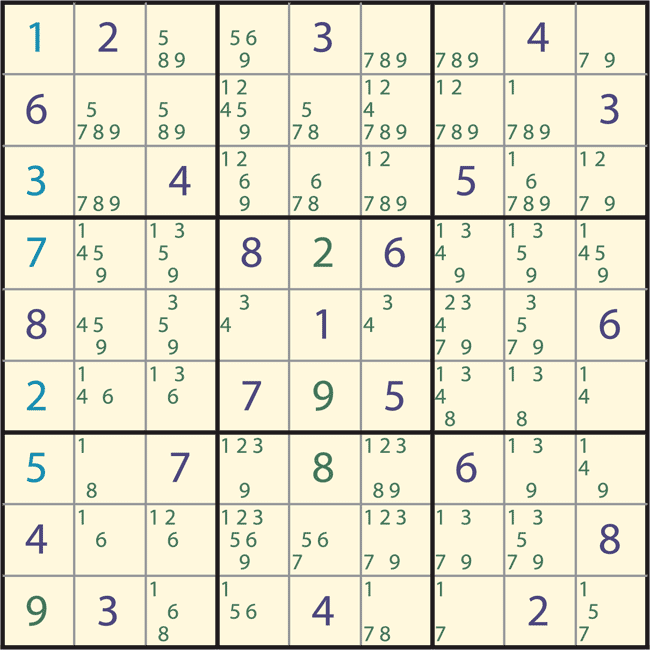
As mathematicians, we seek to prove that a solution to a problem exists, and that it is unique. With Sudoku, neither existence nor uniqueness can easily be determined from the initial clues. For example, with the puzzle shown in Figure 1, if we were to insert a “1”, “5,” or “7” in the (1,1) cell, the row, column, and block conditions would be satisfied but the resulting puzzle would have no solution. It would be very frustrating if such a puzzle were to show up in your newspaper.
Backtracking generates many impossible configurations. Our program terminates the recursion when it encounters a cell that has no candidates. Such puzzles have no solution.
Uniqueness is an elusive property. Most descriptions of Sudoku do not specify that there must be only one solution. Again, it would be frustrating to discover a solution different from the one given. Some of the puzzle-generating programs on MATLAB Central do not check uniqueness. The only way that I know to check for uniqueness is to exhaustively enumerate all possible solutions.