14 April 2026 | Mövenpick Hotel Stuttgart Airport
The event is free, but registration is required.
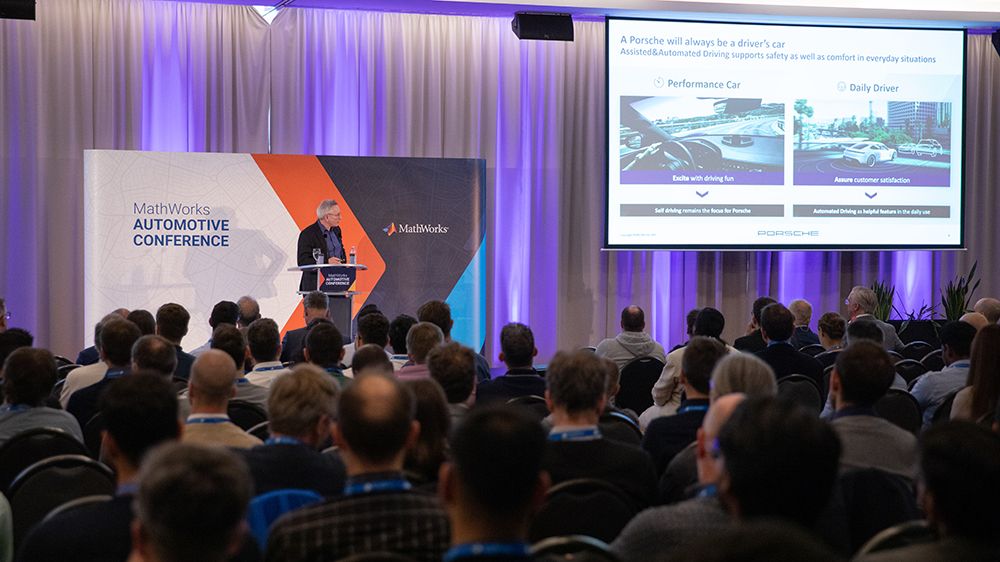
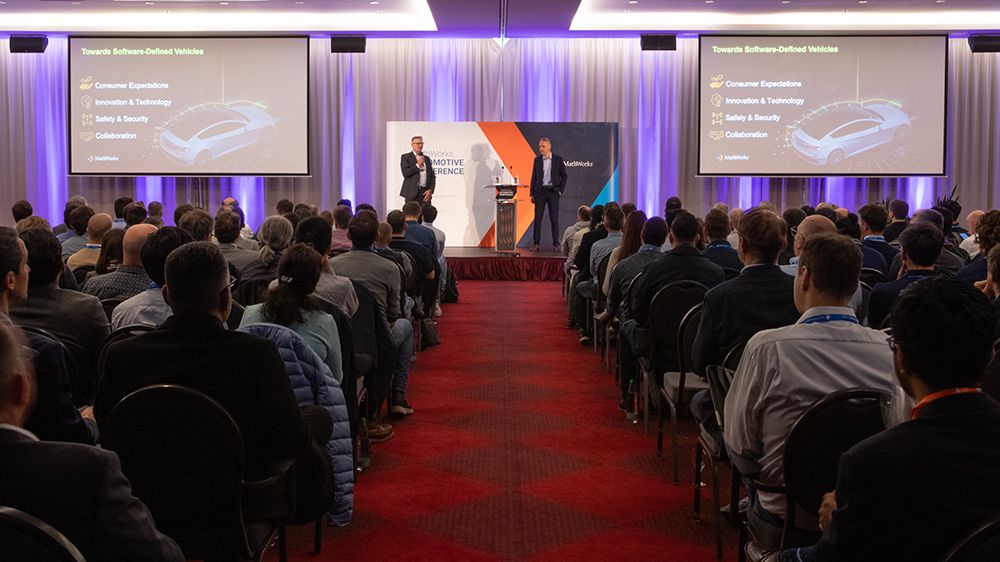
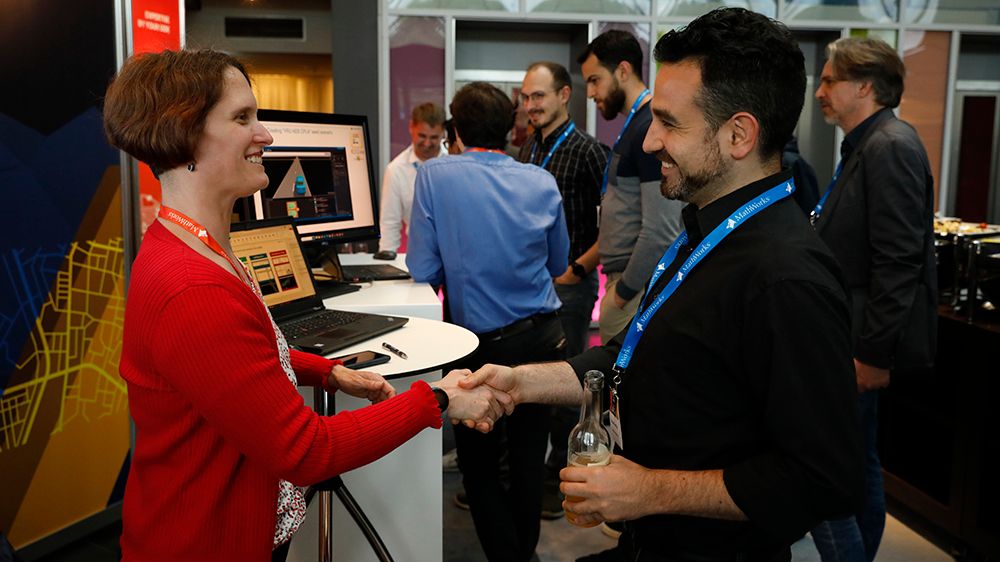
Attend MathWorks Automotive Conference Europe to connect with MathWorks and industry experts and learn more about the latest automotive trends. Discover new features and capabilities for MATLAB and Simulink and hear firsthand how customers are successfully using them.
Keynote: Scaling Software-Defined Vehicles: BMW's CI/CD Architecture for Neue Klasse
As the automotive industry undergoes a fundamental transformation toward software-defined vehicles (SDV), software becomes the primary differentiator in vehicle functionality, safety, and user experience. At BMW, this vision is realized in the Neue Klasse concept featuring four "superbrains" and two actuators—all developed in-house. The software integration and development of high-performance ECUs took place entirely within BMW's engineering organization, and four of these ECUs depend on control systems developed largely with MATLAB® and Simulink®.
To enable this ambitious SDV strategy, BMW architected a cloud-native continuous integration framework capable of producing complete ECU builds several thousand times per day. This presentation reveals how BMW solved one of automotive software's most critical challenges by generating deterministic, scalable code from extensive Simulink model landscapes and integrating it with proprietary basic software and hand-written components.
This solution combines Bazel's hermetic build principles with AWS® infrastructure, enabling reproducible builds and intelligent caching at an unprecedented scale. Learn about the architectural decisions that made this possible, the metrics that illuminated performance bottlenecks, and BMW’s approach to gated testing with and without MATLAB and Simulink. Beyond the technical implementation, hear how operational insights drove continuous improvement in collaboration with MathWorks—demonstrating that achieving SDV leadership requires reimagining the entire software development lifecycle for automotive-grade complexity, as well as advanced tooling.
Since December 2025, Dr. Ralf Schulz has lead the software development and integration for BMW’s Heart of Joy—the central processing unit for driving dynamics within the spectacular Neue Klasse vehicles. Before that, he was responsible for the in-house software platform CASP used in the Heart of Joy, toolchain development for model-based development, high-level Simulink functions to coordinate the powertrain, and the continuous integration performance of BMW’s in-house ECUs. Prior to joining BMW in 2010, he specialized in image and signal processing research, particularly in the field of molecular imaging.
Ralf holds a degree in medical informatics and a Dr. rer. nat. in medical physics, both from Heidelberg University.
Keynote: Model-Based Design Meets GenAI: Delivering Speed and Quality
See how generative AI and Model-Based Design converge to deliver speed, quality, and safety in automotive engineering. Learn how Model-Based Design is evolving to combine AI-driven innovation with proven development practices.
Avinash Nehemiah leads a global team of over 60 product marketers and product managers at MathWorks, specializing in AI, Model-Based Design, wireless communication, computer vision, code generation, and more. His department is responsible for connecting customer and market needs with product roadmap and supporting strategic customers with product adoption. Avinash has over 15 years of experience as a product manager in computer vision, deep learning, and automated driving. Prior to joining MathWorks, he successfully led a team in developing an embedded computer vision-based solution to enhance patient safety in hospital rooms. Avinash earned a master’s degree in electrical and computer engineering from Carnegie Mellon University, where he focused his research on object recognition in radar imagery.
Whole Vehicle Hardware-in-the-Loop: Accelerating Software Validation for Lamborghini
This presentation highlights the development of a scalable hardware-in-the-loop (HIL) simulation platform for next-generation Lamborghini supersport vehicles, enabling real-time testing of the complete vehicle software architecture using MATLAB®, Simulink®, and Simscape™ to model longitudinal and lateral vehicle dynamics along with the full powertrain architecture.
A modular and model-based development approach integrates high-fidelity physical models with real-time execution constraints to achieve an optimal balance between accuracy and computational efficiency. The platform supports direct interfacing with ECUs and embedded controllers, which offers a safe and cost-effective environment for verifying software functions while reducing reliance on physical prototypes.
The framework has been validated against experimental data and optimized for real-time execution. Using Simscape Vehicle Templates and a fully parameterized model architecture reduced the development effort for HIL-ready models by approximately six months compared to a traditional approach. The availability of ready-to-use, detailed, and modular Simscape components accelerated model deployment and enabled significant cost savings.
The open and fully customizable model architecture allowed engineers to extend, adapt, and refine subsystems without vendor lock-in or additional licensing costs, ensuring long-term flexibility, reusability, and scalability across future vehicle platforms.
Validation time was reduced by 45–50 percent, supported by the adoption of automated test suites that increased requirement coverage above 90 percent and significantly shortened regression execution time. Early virtual testing enabled targeted stress-testing of critical edge cases that would be difficult, costly, or unsafe to reproduce on physical prototypes, reducing the overall testing effort and improving software maturity before on-road validation.
Rosario Aliperti leads the test automation team for the Integration Software Whole-Vehicle department at Automobili Lamborghini, where he has worked since 2023. He is responsible for the development of integration facilities used for software integration validation testing, including whole-vehicle HIL, static benches, and system HIL. His work focuses on building and evolving advanced platforms that support reliable validation processes and ensure the robustness of complex automotive software systems.
Rosario has been working in the automotive industry since 2012, specializing in HIL systems, vehicle modeling, and digital twin technologies. His career has spanned several companies within Emilia-Romagna’s Motor Valley and he has contributed to simulation and integration projects across a wide range of vehicles, including sports cars, trucks, and tractors.
Rosario holds a master’s degree in electronic engineering from the University of Napoli.
Francesco Marino is a HIL development technical project leader in the Integration Software Whole Vehicle department at Automobili Lamborghini. In this role, he develops whole vehicle HIL systems supporting comprehensive validation activities across the entire vehicle domain.
Prior to this position, he worked on the vehicle dynamics simulation team where he contributed to the development of chassis HIL systems and their integration with the driving simulator. He has been active in the automotive sector since 2021 with a strong focus on automation and simulation, specializing in HIL system engineering and virtual vehicle models for advanced validation workflows.
Francesco holds a master’s degree in vehicle engineering from the University of Modena.
Software-Defined Design and Control of High Energy Density EV Cells
Customer expectations for EVs now include both long driving range and fast charging, pushing battery energy density to its practical limits. This session explores how software-first, physics-based cell design and charge-control workflows allow engineers at Breathe Battery Technologies to predict trade-offs, expose risk, and accelerate development. By linking electrode design decisions to fast-charging performance and ageing behavior, software enables higher performance without compromising safety or lifetime.
Attendees will gain a detailed understanding of sensitive analyses across key electrode design variables, including cathode loading, N/P ratio, and electrode thickness to quantify their impact on static metrics such as capacity and volumetric energy density. Particular focus is given to anode-potential evolution as a governing constraint for lithium plating risk in energy-dense cells.
Learn how physics-based, closed-loop charging strategies that estimate internal electrochemical states outperform traditional SOC–temperature lookup tables, delivering improved robustness to ageing, better utilization of safety margins, and more consistent fast-charging performance across operating conditions and battery life.
Dr. Yan Zhao is cofounder and CEO of Breathe Battery Technologies. In his role as CEO, Yan is responsible for corporate vision, strategic direction, company operations, and commercial project delivery.
Yan moved from China to the UK for secondary education, where he saw the urgent need to transition from engines to battery powered vehicles. He was motivated to cofound Breathe after observing pollution and emissions while waiting for London buses with his young daughter. His research focused on lithium-ion battery design, thermal management, and simulation. Yan holds a PhD in battery engineering from Imperial College London, has more than 10 published papers, and has created software for cell design that is now used internationally.
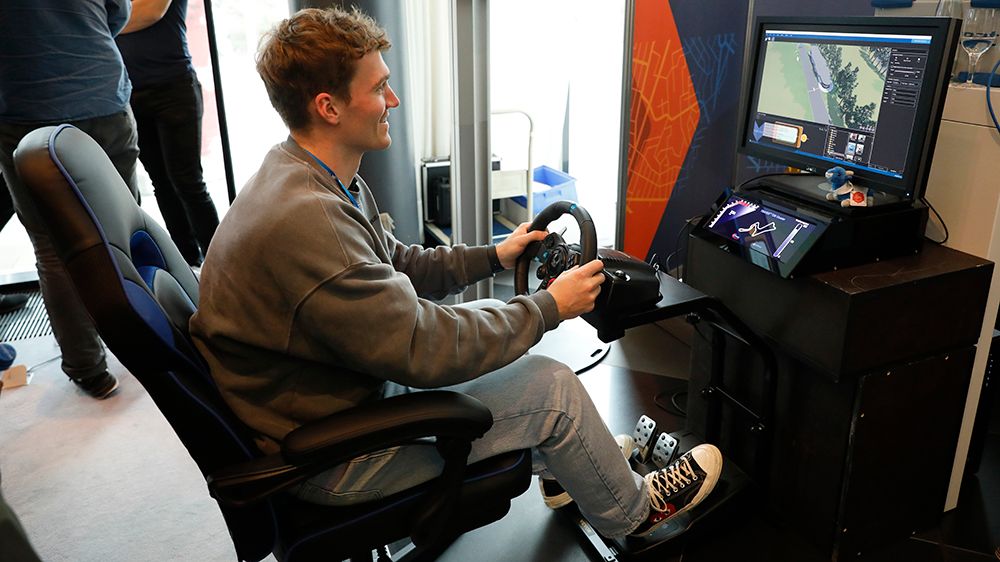
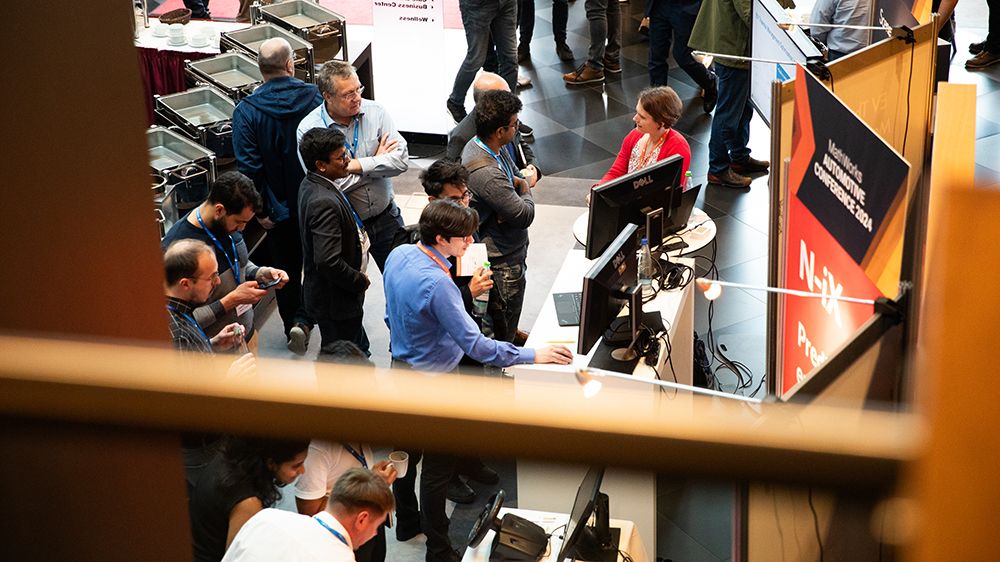
Visit the demo booths at MathWorks Automotive Conference Europe to see product demonstrations, speak with experts, and experience the latest features in MATLAB and Simulink.
Flughafenstrasse 50
70629
Stuttgart
Germany
Paid parking and electric charging stations are available in the underground parking garage. See detailed instructions for how to get the hotel by car.
An environmental sticker is mandatory for all vehicles entering the city center of Stuttgart. You will not need this sticker to access the hotel as it is situated outside of the restricted areas. Learn more.
Secure your spot now to be part of MathWorks Automotive Conference 2026 Europe.
We’ve got answers.
Model-Based Systems Engineering and Software Transformation
Explore these demo booths for Model-Based Systems Engineering and Software Transformation
Demo Booths:
Virtualization and Vehicle Simulation
Explore these demo booths for Virtualization and Vehicle Simulation
Demo booths:
AI and Data Platforms
Explore these demo booths for AI and Data Platforms
Demo booths:
Sélectionner un site web
Choisissez un site web pour accéder au contenu traduit dans votre langue (lorsqu'il est disponible) et voir les événements et les offres locales. D’après votre position, nous vous recommandons de sélectionner la région suivante : .
Vous pouvez également sélectionner un site web dans la liste suivante :
Comment optimiser les performances du site
Pour optimiser les performances du site, sélectionnez la région Chine (en chinois ou en anglais). Les sites de MathWorks pour les autres pays ne sont pas optimisés pour les visites provenant de votre région.
Amériques
Europe