Generate Current Controller Calibration Tables for Torque and Speed-Based Motor Controllers
R2026bUsing the Model-Based Calibration Toolbox™, you can generate optimized calibration tables for torque and speed-based motor controllers.
Based on nonlinear motor flux linkage and torque data, the calibration tables maximize motor efficiency by optimizing:
Maximum torque per ampere (MTPA)
Maximum torque per volt (MTPV)
The calibration tables are d- and q- axis reference currents as functions of one of these combinations:
Motor speed and absolute torque
Motor speed and torque percent
Maximum flux and absolute torque
Maximum flux and torque percent
Torque percent is a percentage of maximum torque at each speed.
You can import data, fit a model, and optimize the data based on objectives and constraints. To generate optimized current calibration tables as functions of motor speed and torque percent, follow these steps.
| Steps | Description |
|---|---|
Collect the nonlinear motor flux data from dynamometer testing
or finite element analysis (FEA). For this example, file
| |
Use a point-by-point model to fit the
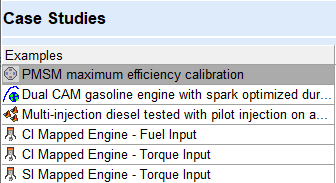
The permanent magnet synchronous motor (PMSM) maximum efficiency calibration case study contains the model fit.
| |
Calibrate and optimize the data using objectives and constraints:
The PMSM maximum efficiency calibration case study contains the calibration results.
| |
| Export calibration results for use in motor control applications. |
References
[1] Hu, Dakai, Yazan Alsmadi, and Longya Xu. “High-Fidelity Nonlinear IPM Modeling Based on Measured Stator Winding Flux Linkage.” IEEE® Transactions on Industry Applications 51, no. 4 (July/August 2015).
[2] Chen, Xiao, Jiabin Wang, Bhaskar Sen, Panagiotis Lasari, and Tianfu Sun. “A High-Fidelity and Computationally Efficient Model for Interior Permanent-Magnet Machines Considering the Magnetic Saturation, Spatial Harmonics, and Iron Loss Effect.” IEEE Transactions on Industrial Electronics 62, no. 7 (July 2015).
[3] Ottosson, J., and M. Alakula. “A Compact Field Awakening Controller Implementation.” International Symposium on Power Electronics, Electrical Drives, Automation and Motion, July 2006.

