Main Content

JTAG Connection

VendorRequired HardwareRequired SoftwareJTAG Clock Frequency
Intel®

USB Blaster I or USB Blaster II download cable

  • USB Blaster I or II driver

  • For Windows® operating systems: Quartus® Prime executable directory must be on system path.

  • For Linux® operating systems: versions below Quartus II 13.1 are not supported. Quartus II 14.1 is not supported. Only 64-bit Quartus is supported. Quartus library directory must be on LD_LIBRARY_PATH before starting MATLAB®. Prepend the Linux distribution library path before the Quartus library on LD_LIBRARY_PATH. For example, /lib/x86_64-linux-gnu:$QUARTUS_PATH.

12 or 24 MHz
AMD®

Digilent® download cable

  • If your board has an onboard Digilent USB-JTAG module, use a USB cable

  • If your board has a standard AMD 14 pin JTAG connector, use with HS2 or HS3 cable from Digilent

  • For Windows operating systems: AMD Vivado® executable directory must be on system path.

  • For Linux operating systems: Digilent Adept 2. For the installation steps, see Install Digilent Adept 2 Runtime (HDL Verifier).

33 MHz

FTDI USB-JTAG cable

  • Supported for boards with onboard FT4232H, FT232H, or FT2232H devices implementing USB-to JTAG

Install these D2XX drivers:

  • For Windows operating systems: 2.12.36.4 (64 bit)

  • For Linux operating systems: 1.4.27 (64 bit)

For the installation guide, see D2XX Drivers from the FTDI Chip website.

15 MHz
Platform Cable USB II

Run the driver installer before you use the cable by following these steps:

  • For Windows operating systems:

    1. Navigate to the C:\Xilinx\Vivado\version_num\data\xicom\cable_drivers\nt64 location, where version_num is the Vivado tool version supported in the current release. For example, C:\Xilinx\Vivado\2024.1\data\xicom\cable_drivers\nt64.

    2. Run the install_drivers_wrapper.bat file.

    3. When the installation is complete, connect the Platform Cable USB II to the USB port of the host machine. Use the 14-conductor ribbon cable to attach the Platform Cable USB II to the target hardware board.

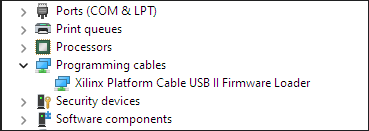
    4. In the Device Manager, make sure that the Xilinx Platform Cable USB II Firmware Loader appears under Programming cables, as this figure shows.

      Device Manager shows Xilinx Platform Cable USB II Firmware Loader under Programming cables.

  • For Linux operating systems:

    1. Navigate to the /home/user/Downloads/Vivado/version_num/data/xicom/cable_drivers/lin64/install_script/install_drivers location, where version_num is the Vivado tool version supported in the current release. For example, /home/user/Downloads/Vivado/2024.1/data/xicom/cable_drivers/lin64/install_script/install_drivers.

    2. Run the install_digilent.sh file.

    3. When the installation is complete, connect the Platform Cable USB II to the USB port of the host machine. Use the 14-conductor ribbon cable to attach the Platform Cable USB II to the target hardware board.

    4. Run the lsusb command and make sure that the Xilinx, Inc. Platform Cable USB II appears under the list, as this example shows.

      % lsusb
      Bus 002 Device 001: ID 1d6b:0003 Linux Foundation 3.0 root hub
      Bus 001 Device 004: ID 14dd:1007 Raritan Computer, Inc. D2CIM-VUSB KVM connector
      Bus 001 Device 003: ID 03fd:0008 Xilinx, Inc. Platform Cable USB II
      Bus 001 Device 002: ID 09fb:6010 Altera DE-SoC
      Bus 001 Device 001: ID 1d6b:0002 Linux Foundation 2.0 root hub
      

For more information about driver installation, see Platform Cable USB II Data Sheet (DS593) from the AMD website.

12 MHz
MicrochipJTAG connection not supported

Note

When simulating your FPGA design through Digilent JTAG cable with Simulink® or MATLAB, you cannot use any debugging software that requires access to the JTAG; for example, Vivado Logic Analyzer.