From DateTime
R2026bFrom DateTime block

To add a block to a model, double-click the canvas and start typing the block name. Then, select the block from the list.
Libraries:
Simulink /
DateTime
Description
The From DateTime block extracts the value of a DateTime input signal.
Examples
This example shows how the From DateTime block converts a DateTime signal to a numerical signal. The block's input is a signal containing the DateTime value 01-Jan-2000 00:00:00. The block's output is the value 946684800, which is the number of seconds between 01-Jan-2000 00:00:00 and the Unix epoch (01-Jan-1970 00:00:00).
model='ex_from_datetime_block';
load_system(model)
sim(model);
open_system(model)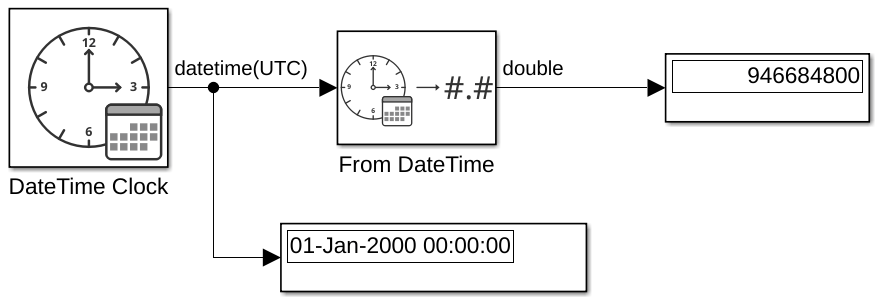
Ports
Input
Output
Block Characteristics
Data Types |
|
Direct Feedthrough |
|
Multidimensional Signals |
|
Variable-Size Signals |
|
Zero-Crossing Detection |
|
Extended Capabilities
Version History
Introduced in R2026b

