min
R2026bMinimum elements of symbolic input
Syntax
Description
M = min(A)
If
Ais a vector, thenmin(A)returns the minimum ofA.If
Ais a matrix, thenmin(A)is a row vector containing the minimum value of each column ofA.
For an input A that contains a symbolic expression, the
symbolic min function returns an unevaluated expression that excludes
elements in A that do not represent minimum values. The output might
have another argument that represents the condition for the symbolic variable. For
example, syms x; min([1 x]) returns the output min([1, x], [],
2, 'omitnan', ~in(x, 'real')) in the Command Window because
x is complex.
Examples
Create a symbolic vector of real elements. Find the smallest real element using the symbolic min function.
syms x real
A = [23 42 37 18 x];
M = min(A)
M =
The symbolic min function returns an unevaluated expression. The expression excludes elements in A that do not represent minimum values.
Create a symbolic vector and compute its minimum, excluding NaN values.
syms x positive
A = [1.75 x 3.25 -2.5 NaN 0.5 NaN 0.2 -4*x];
M = min(A,[],"omitnan")
M =
min(A) also produces this result because "omitnan" is the default option.
Use the "includenan" option to return NaN.
M = min(A,[],"includenan")M =
Create a symbolic matrix and find the smallest element in each column.
syms x real
A = [1 x -0.5; -2 1 x]
A =
M = min(A)
M =
Create a symbolic matrix and find the smallest element in each row.
syms x real
A = [1 x -0.5; -2 1 x]
A =
M = min(A,[],2)
M =
Create a symbolic matrix A. Find the smallest elements in each row of A and return the column indices corresponding to the first occurrence of the minimum value in each row. Because A contains a symbolic variable x with an undetermined value, min cannot explicitly evaluate the minimum value in each row and returns the indices as -1.
syms x real
A = [1 x -0.5; -2 2 x]
A =
[M,I] = min(A,[],2)
M =
I = 2×1

    -1
    -1
Substitute a symbolic number for the variable x in the symbolic matrix A. Find the smallest elements in each row again. Here, min is able to evaluate the minimum values and returns the column indices corresponding to the first occurrence of the minimum value in each row.
A = subs(A,x,sqrt(2))
A =
[M,I] = min(A,[],2)
M =
I = 2×1

     3
     1
Create a symbolic matrix. Find the minimum over all dimensions of the matrix by using the min function with the "all" option.
syms x real
A = [1 x -0.5; -2 1 x]
A =
M = min(A,[],"all")M =
Create two symbolic matrices with complex elements. Find the smallest elements taken from the two matrices. The smallest elements are the complex values with the smallest magnitude.
syms x y
A = [x 2+1i; 3 4i; -5 y]
A =
B = [1 y; 2i 1+1i; -3 x]
B =
C = min(A,B)
C =
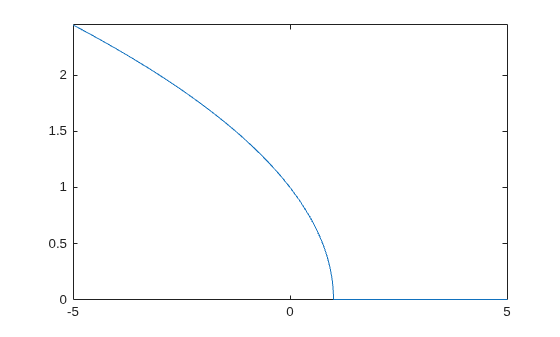
Define the following expression by using the symbolic min function. Assume that the variable is real.
syms x real
f(x) = sqrt(1 - min(x,1))
f(x) =
Plot the expression by using fplot.
fplot(f,[-5 5])
Input Arguments
Input array, specified as a symbolic expression, vector of symbolic expressions, or matrix of symbolic expressions.
If
Ais complex, thenmin(A)returns the complex number with the smallest magnitude. If magnitudes are equal, thenmin(A)returns the value with the smallest magnitude and the smallest phase angle.If
Ais a scalar, thenmin(A)returnsA.If
Ais a 0-by-0 empty array, thenmin(A)is an empty array as well.
Data Types: sym | single | double
Complex Number Support: Yes
Dimension to operate along, specified as a positive integer scalar. If you do not specify a value, then the default is the first array dimension whose size does not equal 1.
Dimension dim indicates the dimension whose length reduces to
1. So, size(M,dim) is 1,
while the sizes of all other dimensions remain the same, unless
size(A,dim) is 0. If
size(A,dim) is 0, then
min(A,dim) returns an empty array with the same size as
A.
Consider a two-dimensional input array, A:
If
dim = 1, thenmin(A,[],1)returns a row vector containing the smallest element in each column.![min(A,[],1) column-wise operation](min_dim_1.png)
If
dim = 2, thenmin(A,[],2)returns a column vector containing the smallest element in each row.![min(A,[],2) row-wise operation](min_dim_2.png)
min returns A if
dim is greater than ndims(A).
NaN condition, specified as one of these values:
"omitnan"— Ignore allNaNvalues in the input. If all elements areNaN, thenminreturns the first one."includenan"— Include theNaNvalues in the input for the calculation.
Additional input array, specified as a symbolic expression, vector of symbolic
expressions, or matrix of symbolic expressions. Inputs A and
B must either be the same size or have sizes that are compatible
(for example, A is an M-by-N
matrix and B is a scalar or
1-by-N row vector). For more information, see
Compatible Array Sizes for Basic Operations.
Data Types: sym | single | double
Complex Number Support: Yes

