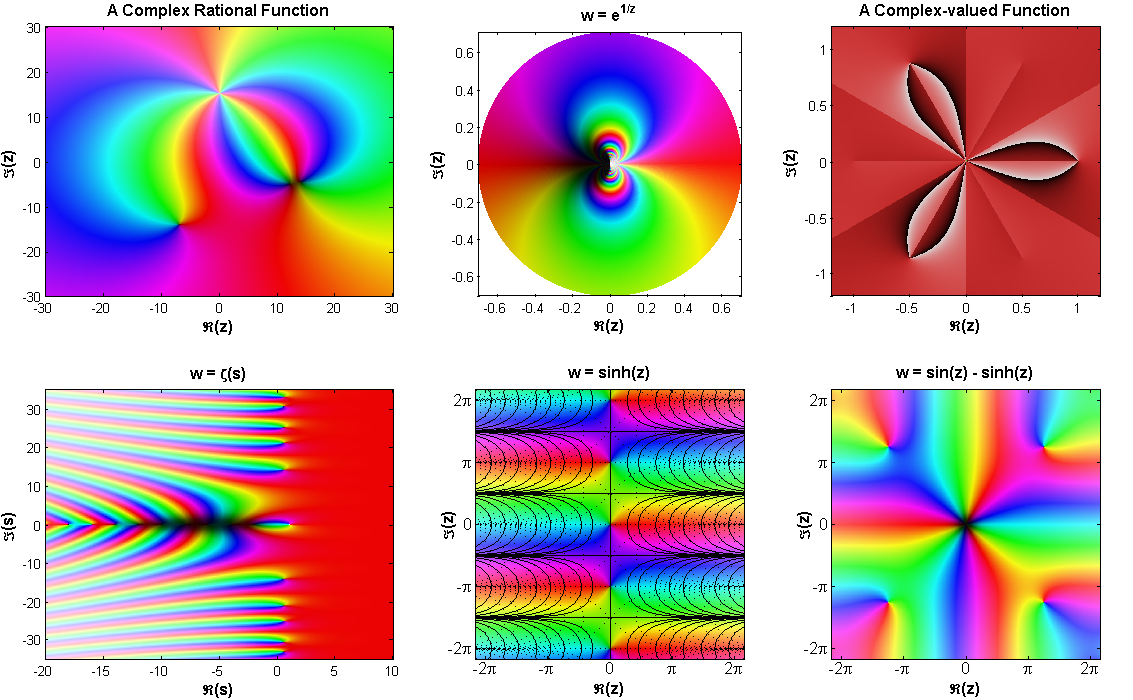

dcolor

Display complex-valued data using domain coloring

You are now following this Submission

DCOLOR uses a coloring function to map the angle and modulus of complex data to color. This technique is known as domain coloring, and is an excellent tool to explore the behavior of complex-valued functions.

DCOLOR can produce plots using either a complex matrix or a function handle as the source data. There are several built-in coloring functions as well as the option to supply a user-defined coloring function as a function handle. Additionally, the 'grid' option can create contours of the real and imaginary parts of the complex data. See the help text for details and usage examples.

The following references have more information about visualizing complex-valued functions using domain coloring, including example images:

http://www.maa.org/pubs/amm_complements/complex.html

http://www.math.liu.se/~halun/complex/domain_coloring-unicode.html

http://www.mathworks.com/company/newsletters/news_notes/clevescorner/summer98.cleve.html

http://commons.wikimedia.org/wiki/User:Jan_Homann/Mathematics

http://www1.american.edu/academic.depts/cas/mathstat/People/lcrone/ComplexPlot.html

http://en.wikipedia.org/wiki/Domain_coloring

Cite As

John Barber (2026). dcolor (https://ch.mathworks.com/matlabcentral/fileexchange/29028-dcolor), MATLAB Central File Exchange. Retrieved .

Acknowledgements

Inspired by: Shaded pseudo color, Domain Coloring

General Information

MATLAB Release Compatibility

  • Compatible with any release

Platform Compatibility

  • Windows
  • macOS
  • Linux
Version Published Release Notes Action
1.2.0.0

- Added option to return image color data as a matrix of RGB values

1.1.0.0

- Added ability to supply function handle to calculate W
- Added new coloring functions
- Added grid option
- Reduced memory usage
- Renamed from cplxpcolor.m to dcolor.m

1.0.0.0