Cascaded Subsystems
R2026bYou can use the 2–port behavioral models for link budget analysis. In this library, frequency-selective components are described as either lumped and distributed elements or as S-parameters.
Blocks
 | General Amplifier | Model nonlinear amplifier described by object or file data |
 | S-Parameters Amplifier | Model nonlinear amplifier using S-parameters |
 | Y-Parameters Amplifier | Model nonlinear amplifier using Y-parameters |
 | Z-Parameters Amplifier | Model nonlinear amplifier using Z-parameters |
 | General Mixer | Model mixer and local oscillator described by rfdata
object |
 | S-Parameters Mixer | Model mixer and local oscillator using S-parameters |
 | Y-Parameters Mixer | Model mixer and local oscillator using Y-parameters |
 | Z-Parameters Mixer | Model mixer and local oscillator using Z-parameters |
 | LC Bandpass Pi | Model LC bandpass pi network |
 | LC Bandpass Tee | Model LC bandpass tee network |
 | LC Bandstop Pi | Model LC bandstop pi network |
 | LC Bandstop Tee | Model LC bandstop tee network |
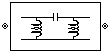 | LC Highpass Pi | Model LC highpass pi network |
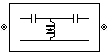 | LC Highpass Tee | Model LC highpass tee network |
 | LC Lowpass Pi | Model LC lowpass pi network |
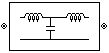 | LC Lowpass Tee | Model LC lowpass tee network |

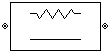
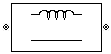
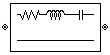
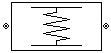
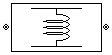


 | Coaxial Transmission Line | Model coaxial transmission line |
 | Microstrip Transmission Line | Model microstrip transmission line |
 | Parallel-Plate Transmission Line | Model parallel-plate transmission line |
 | RLCG Transmission Line | Model RLCG transmission line |
 | Two-Wire Transmission Line | Model two-wire transmission line |
 | Coplanar Waveguide Transmission Line | Model coplanar waveguide transmission line |
 | Connection Port | Connection port for RF subsystem |
 | Input Port | Connection block from Simulink environment to RF physical blocks |
 | Output Port | Connection block from RF physical blocks to Simulink environment |
Topics
- Create Complex Baseband-Equivalent Model
Describes how RF Blockset™ software uses the frequency-domain parameters of the RF blocks to create a baseband-equivalent model for time-domain simulation.
- Convert to and from Simulink Signals
Explains how the Input Port and Output Port convert Simulink® signals to and from the physical modeling environment during a simulation.
- Model Nonlinearity
Explains how to specify amplifier and mixer nonlinearity in a physical system.
- Model Noise
Explains how to model noise in a physical system.
- Model a Mixer Chain
Explains which frequencies RF Blockset Equivalent Baseband software models for each component when simulating a cascade that includes a mixer.
- Quadrature Mixers
Explains how to model upconversion and downconversion quadrature mixers.
- Model RF Components
Describes how to add and connect blocks in a Simulink model to represent RF components.
Featured Examples
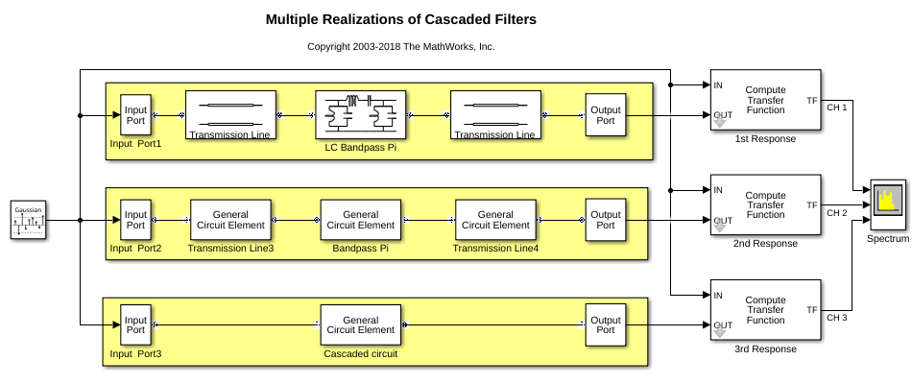
Multiple Realizations of Cascaded Filters
Learn three different ways to implement filters.
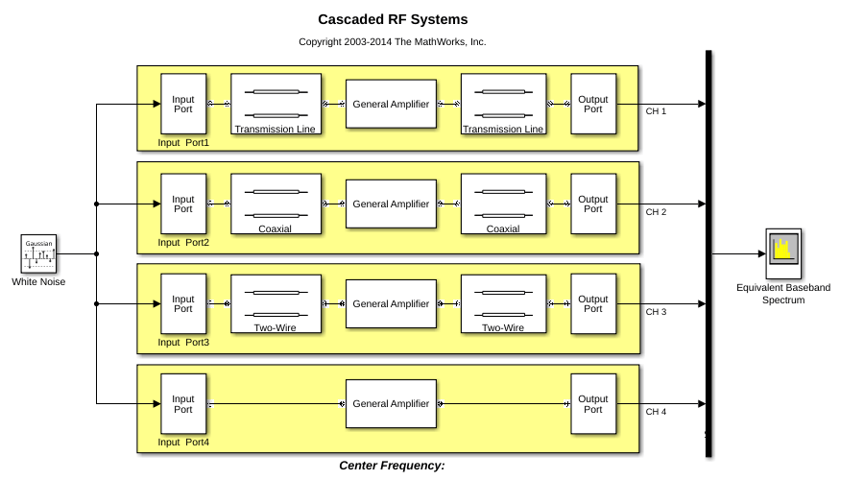
Cascaded RF Systems
Learn how to build cascaded RF system.

