network
R2026b(To be removed) Create custom shallow neural network
network will be removed in a future release. For more information,
see Transition Legacy Neural Network Code to dlnetwork Workflows.
For advice on updating your code, see Version History.
Description
network creates new custom networks. It is used to create
networks that are then customized by functions such as feedforwardnet and
narxnet.
Creation
Syntax
Description
net = network
net = network(
specifies additional neural network options.numInputs,numLayers,biasConnect,inputConnect,layerConnect,outputConnect)
Input Arguments
Properties
General
Network name, specified as a string. Network creation functions, such as
feedforwardnet, define this appropriately. But it can be set to
any string as desired.
User data, specified as a structure.
Place for users to add custom information to a network object. Only one field is predefined. It contains a secret message to all Deep Learning Toolbox™ users:
net.userdata.note
Architecture
Number of inputs, specified as a nonnegative integer.
The number of network inputs and the size of a network input are
not the same thing. The number of inputs defines how many sets
of vectors the network receives as input. The size of each input (i.e., the number of
elements in each input vector) is determined by the input size
(net.inputs{i}.size).
Most networks have only one input, whose size is determined by the problem.
Any change to this property results in a change in the size of the matrix defining
connections to layers from inputs, (net.inputConnect) and the size
of the cell array of input subobjects (net.inputs).
Number of layers, specified as a nonnegative integer.
Any change to this property changes the size of each of these Boolean matrices that define connections to and from layers:
net.biasConnect
net.inputConnect
net.layerConnect
net.outputConnect
and changes the size of each cell array of subobject structures whose size depends on the number of layers:
and changes the size of each cell array of subobject structures whose size depends on the number of layers:
and also changes the size of each of the network's adjustable parameter's properties:
net.IW
net.LW
net.b
Bias connections, specified as a numLayers-by-1 logical
vector.
If net.biasConnect(i) is 1, then layer i has
a bias, and net.biases{i} is a structure describing that
bias.
Any change to this property alters the presence or absence of structures in the
cell array of biases (net.biases) and, in the presence or absence
of vectors in the cell array, of bias vectors (net.b).
Input connections, specified as a
numLayers-by-numInputs logical matrix.
If net.inputConnect(i,j) is 1, then layer i
has a weight coming from input j, and
net.inputWeights{i,j} is a structure describing that
weight.
Any change to this property alters the presence or absence of structures in the
cell array of input weight subobjects (net.inputWeights) and the
presence or absence of matrices in the cell array of input weight matrices
(net.IW).
Layer connections, specified as a
numLayer-by-numLayers logical vector.
If net.layerConnect(i,j) is 1, then layer i
has a weight coming from layer j, and
net.layerWeights{i,j} is a structure describing that
weight.
Any change to this property alters the presence or absence of structures in the
cell array of layer weight subobjects (net.layerWeights) and the
presence or absence of matrices in the cell array of layer weight matrices
(net.LW).
Outputs connections, specified as a 1-by-numLayers logical
vector.
If net.outputConnect(i) is 1, then the network has an output
from layer i, and net.outputs{i} is a structure
describing that output.
Any change to this property alters the number of network outputs
(net.numOutputs) and the presence or absence of structures in the
cell array of output subobjects (net.outputs).
This property is read-only.
Number of network outputs according to net.outputConnect,
specified as a nonnegative integer.
This property is read-only.
Maximum layer delay according to all
net.layerWeights{i,j}.delays, specified as a nonnegative
integer.
This property indicates the number of time steps of past layer outputs that must be supplied to simulate the network. It is always set to the maximum delay value associated with any of the network's layer weights:
numLayerDelays = 0;
for i=1:net.numLayers
  for j=1:net.numLayers
    if net.layerConnect(i,j)
      numLayerDelays = max( ...
       [numLayerDelays net.layerWeights{i,j}.delays]);
    end
  end
end
This property is read-only.
Number of weight and bias values in the network, specified as a nonnegative integer. It is the sum of the number of elements in the matrices stored in the two cell arrays:
net.IW
new.b
Subobject Structure
Inputs, specified as a numInputs-by-1 cell array.
net.inputs{i} is a structure defining input
i.
If a neural network has only one input, then you can access
net.inputs{1} without the cell array notation as follows:
net.input
The input objects have these properties:
| Property | Description |
|---|---|
net.inputs{i}.name | String defining the input name. Network creation functions, such
as |
net.inputs{i}.feedbackInput (read only) | If this network is associated with an open-loop feedback output, then this property will indicate the index of that output. Otherwise it will be an empty matrix. |
net.inputs{i}.processFcns | Row cell array of processing function names to be used by ith network input. The processing functions are applied to input values before the network uses them. Whenever
this property is altered, the input For a list of processing
functions, type |
net.inputs{i}.processParams | Row cell array of processing function parameters to be used by ith network input. The processing parameters are applied by the processing functions to input values before the network uses them. Whenever this property is altered, the input
|
net.inputs{i}.processSettings (read only) | Row cell array of processing function settings to be used by
ith network input. The processing settings are found
by applying the processing functions and parameters to
|
net.inputs{i}.processedRange (read only) | Range of |
net.inputs{i}.processedSize (read only) | Number of rows in the |
net.inputs{i}.range | Range of each element of the ith network input. It can be set to any
Ri × 2 matrix, where
Ri is the number of elements
in the input ( Each jth row defines the minimum and maximum values of the jth input element, in that order: net.inputs{i}(j,:)
Some initialization functions use input ranges to find appropriate initial values for input weight matrices. Whenever the number of rows in this property is
altered, the input |
net.inputs{i}.size | Number of elements in the ith network input. It can be set to 0 or a positive integer. Whenever this
property is altered, the input |
net.inputs{i}.userdata | Place for users to add custom information to the ith network input. |
Layers, specified as a numLayers-by-1 cell array.
net.layers{i} is a structure defining layer
i.
The layer objects have these properties:
| Property | Description |
|---|---|
net.layers{i}.name | String defining the layer name. Network creation functions, such
as |
net.layers{i}.dimensions | Physical dimensions of the ith layer's neurons. Being able to arrange a layer's neurons in a multidimensional manner is important for self-organizing maps. It can be set to any row vector of 0 or positive integer
elements, where the product of all the elements becomes the number of
neurons in the layer
( Layer dimensions are
used to calculate the neuron positions within the layer
( Whenever this
property is altered, the layer's size
( |
net.layers{i}.distanceFcn | Which of the distance functions is used
to calculate For a list of functions, type Whenever this property is altered, the
distances between the layer's neurons
( |
net.layers{i}.distances (read only) | Distances between neurons in the ith layer. These distances are used by self-organizing maps: It is always
set to the result of applying the layer's distance function
( |
net.layers{i}.initFcn | Which of the layer initialization functions are used to
initialize the ith layer, if the network initialization
function ( |
net.layers{i}.netInputFcn | Which of the net input functions is used to calculate the ith layer's net input, given the layer's weighted inputs and bias during simulating and training. For a list of
functions, type |
net.layers{i}.netInputParam | Parameters of the layer's net input function. Call
help(net.layers{i}.netInputFcn)
|
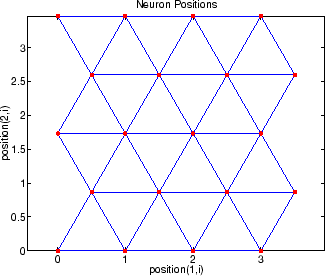
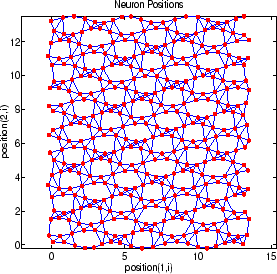
net.layers{i}.positions (read only) | Positions of neurons in the ith layer. These positions are used by self-organizing maps. It is always set
to the result of applying the layer's topology function
( Use For instance, if the
first-layer neurons of a network are arranged with dimensions
( plotsom(net.layers{1}.positions)
|
net.layers{i}.range (read only) | Output range of each neuron of the ith layer. It is set to an
Si × 2 matrix, where
Si is the number of neurons
in the layer ( Each
jth row defines the minimum and maximum output values
of the layer's transfer function
|
net.layers{i}.size | Number of neurons in the ith layer. It can be set to 0 or a positive integer. Whenever this property is
altered, the sizes of any input weights going to the layer
( The dimensions of the corresponding weight matrices
( Changing this
property also changes the size of the layer's output
( Finally, when this property is altered, the dimensions
of the layer's neurons ( |
net.layers{i}.topologyFcn | Which of the topology functions are used to calculate the
ith layer's neuron positions
( For a list of
functions, type Whenever
this property is altered, the positions of the layer's neurons
( Use plotsom(net.layers{1}.positions)
|
net.layers{i}.transferFcn | Which of the transfer functions is used to calculate the ith layer's output, given the layer's net input, during simulation and training. For a list of
functions, type |
net.layers{i}.transferParam | Parameters of the layer's transfer function. Call
help(net.layers{i}.transferFcn)
|
net.layers{i}.userdata | This property provides a place for users to add custom information to the ith network layer. |
Biases, specified as a numLayers-by-1 cell array.
If net.biasConnect(i) is 1, then
net.biases{i} is a structure defining the bias for layer
i.
The biases objects have these properties:
| Property | Description |
|---|---|
net.biases{i}.initFcn | Weight and bias initialization functions used to set the
ith layer's bias vector ( |
net.biases{i}.learn | Whether the ith bias vector is to be altered during training and adaption. It can be set to 0 or 1. It
enables or disables the bias's learning during calls to
|
net.biases{i}.learnFcn | Which of the learning functions is used to update the
ith layer's bias vector ( For a list of
functions, type Whenever this
property is altered, the biases learning parameters
( |
net.biases{i}.learnParam | Learning parameters and values for the current learning function
of the ith layer's bias. The fields of this property
depend on the current learning function. Call |
net.biases{i}.size (read only) | Size of the ith layer's bias vector. It is
always set to the size of the ith layer
( |
net.biases{i}.userdata | This property provides a place for users to add custom information to the ith layer's bias. |
Input weights, specified as a
numLayers-by-numLayers cell array.
If net.inputConnect(i,j) is 1, then
net.inputWeights{i,j} is a structure defining the weight to layer
i from input j.
The input weights objects have these properties:
| Property | Description |
|---|---|
net.inputWeights{i,j}.delays | Tapped delay line between the jth input and its weight to the ith layer. It must be set to a row vector of increasing values. The elements must be either 0 or positive integers. Whenever this property is altered, the weight's size
( |
net.inputWeights{i,j}.initFcn | Which of the Weight and Bias Initialization Functions is used to
initialize the weight matrix ( |
net.inputWeights{i,j}.initSettings (read
only) | Values useful for initializing the weight as part of the
configuration process that occurs automatically the first time a network
is trained, or when the function |
net.inputWeights{i,j}.learn | Whether the weight matrix to the ith layer from the jth input is to be altered during training and adaption. It can be set to 0 or 1. |
net.inputWeights{i,j}.learnFcn | Which of the learning functions is used to update the weight
matrix ( For a
list of functions, type |
net.inputWeights{i,j}.learnParam | Learning parameters and values for the current learning function of the ith layer's weight coming from the jth input. The fields of this property
depend on the current learning function
( Call |
net.inputWeights{i,j}.size (read only) | Dimensions of the ith layer's weight matrix
from the jth network input. It is always set to a
two-element row vector indicating the number of rows and columns of the
associated weight matrix ( length(net.inputWeights{i,j}.delays) * net.inputs{j}.size
|
net.inputWeights{i,j}.userdata | Place for users to add custom information to the (i,j)th input weight. |
net.inputWeights{i,j}.weightFcn | Which of the weight functions is used to apply the ith layer's weight from the jth input to that input. It can be set to the name of any weight function. The weight function is used to transform layer inputs during simulation and training. For a list of functions, type |
net.inputWeights{i,j}.weightParam | Parameters of the layer's net input function. Call
|
Layer weights, specified as a
numLayers-by-numLayers cell array.
If net.layerConnect(i,j) is 1, then
net.layerWeights{i,j} is a structure defining the weight to layer
i from layer j.
The layer weights objects have these properties:
| Property | Description |
|---|---|
net.layerWeights{i,j}.delays | Tapped delay line between the jth layer and its weight to the ith layer. It must be set to a row vector of increasing values. The elements must be either 0 or positive integers. |
net.layerWeights{i,j}.initFcn | Which of the weight and bias initialization functions is used to
initialize the weight matrix ( |
net.layerWeights{i,j}.initSettings (read
only) | Values useful for initializing the weight as part of the
configuration process that occurs automatically the first time a network
is trained, or when the function |
net.layerWeights{i,j}.learn | Whether the weight matrix to the ith layer from the jth layer is to be altered during training and adaption. It can be set to 0 or 1. |
net.layerWeights{i,j}.learnFcn | Which of the learning functions is used to update the weight
matrix ( For a
list of functions, type |
net.layerWeights{i,j}.learnParam | Learning parameters fields and values for the current learning
function of the ith layer's weight coming from the
jth layer. The fields of this property depend on the
current learning function. Call |
net.layerWeights{i,j}.size (read only) | Dimensions of the ith layer's weight matrix
from the jth layer. It is always set to a two-element
row vector indicating the number of rows and columns of the associated
weight matrix ( |
net.layerWeights{i,j}.userdata | Place for users to add custom information to the (i,j)th layer weight. |
net.layerWeights{i,j}.weightFcn | Which of the weight functions is used to apply the ith layer's weight from the jth layer to that layer's output. It can be set to the name of any weight function. The weight function is used to transform layer inputs when the network is simulated. For a list of functions, type
|
net.layerWeights{i,j}.weightParam | Parameters of the layer's net input function. Call
|
Outputs, specified as a 1-by-numLayers cell array.
If net.outputConnect(i) is 1, then
net.outputs{i} is a structure defining the network output from
layer i.
If a neural network has only one output at layer i, then you
can access net.outputs{i} without the cell array notation as
follows:
net.output
The output objects have these properties:
| Property | Description |
|---|---|
net.outputs{i}.name | String defining the output name. Network creation functions, such
as |
net.outputs{i}.feedbackInput | If the output implements open-loop feedback
( |
net.outputs{i}.feedbackDelay | Timestep difference between this output and network inputs.
Input-to-output network delays can be removed and added with
|
net.outputs{i}.feedbackMode | String |
net.outputs{i}.processFcns | Row cell array of processing function names to be used by the ith network output. The processing functions are applied to target values before the network uses them, and applied in reverse to layer output values before being returned as network output values. When you change this property, you also affect the
following settings: the output parameters For
a list of functions, type |
net.outputs{i}.processParams | Row cell array of processing function parameters to be used by ith network output on target values. The processing parameters are applied by the processing functions to input values before the network uses them. Whenever this property is altered, the
output |
net.outputs{i}.processSettings (read only) | Row cell array of processing function settings to be used by
ith network output. The processing settings are found
by applying the processing functions and parameters to
|
net.outputs{i}.processedRange (read only) | Range of |
net.outputs{i}.processedSize (read only) | Number of rows in the |
net.outputs{i}.size (read only) | Number of elements in the ith layer's output.
It is always set to the size of the ith layer
( |
net.outputs{i}.userdata | Place for users to add custom information to the ith layer's output. |
Function
Network adaption function, specified as a string.
Name of a network adaption function or ''
The network adapt function is used to perform adaption whenever
adapt is called.
[net,Y,E,Pf,Af] = adapt(NET,P,T,Pi,Ai)
For a list of functions, type help nntrain.
Whenever this property is altered, the network's adaption parameters
(net.adaptParam) are set to contain the parameters and default
values of the new function.
Derivative function, specified as a string.
This property defines the derivative function to be used to calculate error gradients and Jacobians when the network is trained using a supervised algorithm, such as backpropagation. You can set this property to the name of any derivative function.
For a list of functions, type help nnderivative.
Data division function, specified as a string.
This property defines the data division function to be used when the network is trained using a supervised algorithm, such as backpropagation. You can set this property to the name of a division function.
For a list of functions, type help nndivision.
Whenever this property is altered, the network's adaption parameters
(net.divideParam) are set to contain the parameters and default
values of the new function.
Network initialization function, specified as a string.
This property defines the function used to initialize the network's weight
matrices and bias vectors. The initialization function is used to initialize the
network whenever init is called:
net = init(net)
Whenever this property is altered, the network's initialization parameters
(net.initParam) are set to contain the parameters and default
values of the new function.
Network performance function, specified as a string.
This property defines the function used to measure
the network’s performance. The performance function is used to calculate network
performance during training whenever train is called.
[net,tr] = train(NET,P,T,Pi,Ai)
For a list of functions, type help nnperformance.
Whenever this property is altered, the network's performance parameters
(net.performParam) are set to contain the parameters and default
values of the new function.
Plot functions, specified as a cell array.
This property consists of a row cell array of strings, defining the plot functions
associated with a network. The neural network training window, which is opened by the
train function, shows a button for each plotting function.
Click the button during or after training to open the desired plot.
Network training function, specified as a string.
This property defines the function used to train the network. It can be set to the
name of any of the training functions, which is used to train the network whenever
train is called.
[net,tr] = train(NET,P,T,Pi,Ai)
For a list of functions, type help nntrain.
Parameter
Network adaption parameters, specified as a parameter object.
Call help on the current adapt function to get a description of
what each field means:
help(net.adaptFcn)
Network data division parameters, specified as a parameter object.
This property defines the parameters and values of the current data-division function. To get a description of what each field means, type the following command:
help(net.divideFcn)
Data division mode, specified as a string.
This property defines the target data dimensions which to divide up when the data
division function is called. Its default value is 'sample' for
static networks and 'time' for dynamic networks. It may also be set
to 'sampletime' to divide targets by both sample and timestep,
'all' to divide up targets by every scalar value, or
'none' to not divide up data at all (in which case all data is
used for training, none for validation or testing).
Network initialization parameters, specified as a parameter object.
This property defines the parameters and values of the current initialization
function. Call help on the current initialization function to get a
description of what each field means:
help(net.initFcn)
Network initialization parameters, specified as a cell array of parameter objects.
This property consists of a row cell array of parameter objects, defining the
parameters and values of each plot function in net.plotFcns. Call
help on the each plot function to get a description of what each
field means:
help(net.plotFcns{i})
Training function parameters, specified as a parameter object.
This property defines the parameters and values of the current training function.
Call help on the current training function to get a description of
what each field means:
help(net.trainFcn)
Weight and Bias Value
Input weight values, specified as a
numLayers-by-numInputs cell array of input
weight values.
The weight matrix for the weight going to the ith layer from
the jth input (or a null matrix []) is located
at net.IW{i,j} if net.inputConnect(i,j) is
1 (or 0).
The weight matrix has as many rows as the size of the layer it goes to
(net.layers{i}.size). It has as many columns as the product of
the input size with the number of delays associated with the weight:
net.inputs{j}.size * length(net.inputWeights{i,j}.delays)
The preprocessing function net.inputs{i}.processFcns is
specified as 'removeconstantrows' by default in some networks. In
this case, if the network input X contains m
rows where all row elements have the same value, the weight matrix has
m less columns than the above product. For more details about the
network input X, see train.
These dimensions can also be obtained from the input weight properties:
net.inputWeights{i,j}.size
Layer weight values, specified as a
numLayers-by-numLayers cell array of layer
weight values.
The weight matrix for the weight going to the ith layer from
the jth layer (or a null matrix []) is located
at net.LW{i,j} if net.layerConnect(i,j) is 1 (or
0).
The weight matrix has as many rows as the size of the layer it goes to
(net.layers{i}.size). It has as many columns as the product of
the size of the layer it comes from with the number of delays associated with the
weight:
net.layers{j}.size * length(net.layerWeights{i,j}.delays)
These dimensions can also be obtained from the layer weight properties:
net.layerWeights{i,j}.size
Bias values, specified as a numLayers-by-1 cell array of bias
values.
The bias vector for the ith layer (or a null matrix
[]) is located at net.b{i} if
net.biasConnect(i) is 1 (or 0).
The number of elements in the bias vector is always equal to the size of the layer
it is associated with (net.layers{i}.size).
This dimension can also be obtained from the bias properties:
net.biases{i}.size
Examples
Create Network with One Input and Two Layers
This example shows how to create a network without any inputs and layers, and then set its numbers of inputs and layers to 1 and 2 respectively.
net = network
net.numInputs = 1
net.numLayers = 2
Alternatively, you can create the same network with one line of code.
net = network(1,2)
Version History
Introduced before R2006aSee Also
Time Series Modeler | fitrnet (Statistics and Machine Learning Toolbox) | fitcnet (Statistics and Machine Learning Toolbox) | trainnet | trainingOptions | dlnetwork

