Normalization
R2026bPerform vector normalization along rows, columns, or specified dimension
Normalization block

To add a block to a model, double-click the canvas and start typing the block name. Then, select the block from the list.
Libraries:
DSP System Toolbox /
Math Functions /
Math Operations
Description
The Normalization block independently normalizes each row, column, or
vector of the specified dimension of the input using the Squared
2-norm or the 2-norm methods.
For more information on how the block normalizes the signal, see Algorithms.
Examples
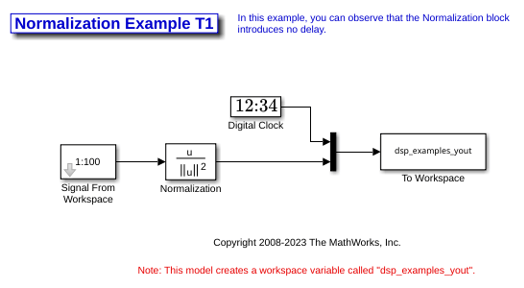
Zero Algorithmic Delay
The FFT block is an example of a component that has no algorithmic delay. The Simulink timer does not record any passage of time while the block computes the FFT of the input, and the transformed data is available at the output in the same time step that the input is received. There are many other blocks that have zero algorithmic delay, such as the blocks in the Matrices and Linear Algebra libraries. Each of those blocks processes its input and generates its output in a single time step.
Ports
Input
Output
Parameters
Main Tab
Specify the type of normalization to perform as one of these:
Squared 2-norm— Supports both floating-point and fixed-point signals.2-norm— Supports only floating-point signals.
Specify the normalization bias as a nonnegative scalar. This is the real value b which the block adds in the denominator to avoid division by zero.
Tunable: Yes
Specify the dimension over which to normalize as one of these:
Each columnEach rowSpecified dimension— Use the Dimension parameter to specify the dimension.
Specify the one-based value of the dimension over which to normalize as a positive integer. The value of this parameter cannot exceed the number of dimensions in the input signal.
Dependencies
To enable this parameter, set the Normalize
over parameter to Specified
dimension.
Data Types Tab
Note
The parameters on this tab are applicable only to fixed-point signals when the block is in squared 2-norm mode. See Fixed-Point Data Types for a diagram of how the product output, accumulator, and output data types are used in this case.
Specify the rounding mode for fixed-point operations as one of the following:
FloorCeilingConvergentNearestRoundSimplestZero
For more details, see Rounding Modes.
When you select this parameter, the block saturates the result of its
fixed-point operation. When you clear this parameter, the block wraps
the result of its fixed-point operation. For details on
saturate and wrap, see overflow
mode for fixed-point operations.
Specify the product output data type. See Fixed-Point Data Types and Multiplication Data Types for illustrations depicting the use of the product output data type in this block. You can set it to:
A rule that inherits a data type, for example,
Inherit: Same as inputAn expression that evaluates to a valid data type, for example,
fixdt([],16,0)
Click the Show data type assistant button
 to display the Data Type
Assistant, which helps you set the Product
output parameter.
See Specify Data Types Using Data Type Assistant (Simulink) for more information.
Specify the accumulator data type. See Fixed-Point Data Types for illustrations depicting the use of the accumulator data type in this block. You can set this parameter to:
A rule that inherits a data type, for example,
Inherit: Same as product outputA rule that inherits a data type, for example,
Inherit: Same as inputAn expression that evaluates to a valid data type, for example,
fixdt([],16,0)
Click the Show data type assistant button
to display the Data Type
Assistant, which helps you set the
Accumulator parameter.
See Specify Data Types Using Data Type Assistant (Simulink) for more information.
Specify the output data type. See Fixed-Point Data Types for illustrations depicting the use of the output data type in this block. You can set this parameter to:
A rule that inherits a data type, for example,
Inherit: Same as product
									output
A rule that inherits a data type, for example,
Inherit: Same as inputA rule that inherits a data type, for example,
Inherit: Same as
									accumulator
An expression that evaluates to a valid data type, for example,
fixdt([],16,0)
Click the Show data type assistant button
to display the Data Type
Assistant, which helps you set the
Output parameter.
See Control Data Types of Signals (Simulink) for more information.
Specify the minimum value that the block should output. The default
value is [] (unspecified). Simulink® software uses this value to perform:
Simulation range checking (see Specify Signal Ranges (Simulink))
Automatic scaling of fixed-point data types
Specify the maximum value that the block should output. The default
value is [] (unspecified). Simulink software uses this value to perform:
Simulation range checking (see Specify Signal Ranges (Simulink))
Automatic scaling of fixed-point data types
Block Characteristics
Data Types |
|
Direct Feedthrough |
|
Multidimensional Signals |
|
Variable-Size Signals |
|
Zero-Crossing Detection |
|
Programmatic Use: Add Block
To add the block programmatically, use the add_block function with one of these library block paths as the source.
"dspmathops/Normalization"
Example: add_block("dspmathops/Normalization","myModel/myBlock",MakeNameUnique="on")
More About
This diagram shows the data types used within the Normalization block for fixed-point signals (squared 2-norm mode only).

The output of the multiplier is in the product output data type when the input is real. When the input is complex, the result of the multiplication is in the accumulator data type. For details on the complex multiplication performed, see Multiplication Data Types. You can set the accumulator, product output, and output data types in the block dialog box.
Algorithms
This block treats an arbitrarily dimensioned input U as a collection of vectors oriented along the specified dimension. The block normalizes these vectors by either their norm or the square of their norm.
For example, consider a 3-D input U(i,j,k) and assume that you want to normalize along the second dimension. First, define the 2-D intermediate quantity V(i,k) such that each element of V is the norm of one of the vectors in U
Given V, the output of the block Y(i,j,k) in 2-norm mode is given by
In squared 2-norm mode, the block output is given by
The normalization bias b is typically chosen to be a small positive constant (for example, 1e-10) that prevents potential division by zero.
Extended Capabilities
Version History
Introduced before R2006a

